
From R&D prototype to production on the factory floor.
Fives Lund built COAST, a real-time optical inspection system for robotic composite fabrication. We helped carry it from a validation tool (TRL 6) to a production-ready product operators could run every shift (TRL 7 to 8).
A custom stack, a competitive clock.
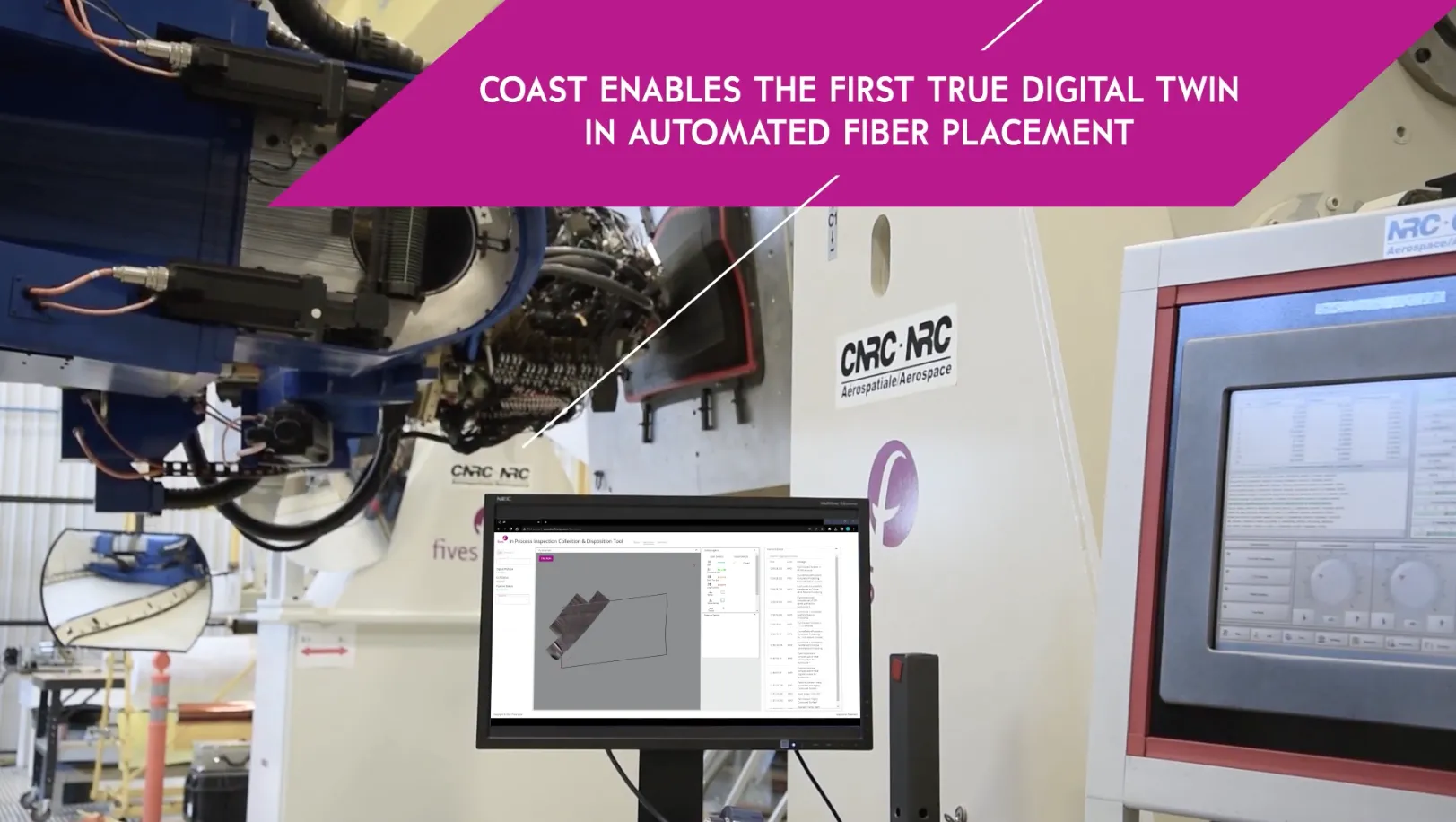
Fives Lund, a leader in industrial solutions, had developed an edge-compute solution for real-time inspection of its robotic composite work cell. The system uses Optical Coherence Tomography licensed from the National Research Council of Canada to inspect each layer as it is laid down, on a hardware and software stack that is entirely their own.
The first application had done its job: it validated the technology for engineers. But an operator on the floor needs something different. We were brought in to deliver the first public release, converting the application from an engineering and validation tool into a production system, while the Fives team matured the mechatronics and analysis software in parallel.
Two constraints shaped everything: preserve the working codebase, and reach production readiness on a contractual timeline.
Three problems that had to be solved together.
An interface built for engineers, not operators
The existing UI was optimized for measurement-system analysis, validation and qualification. Factory-floor operations needed a separate, purpose-built interface for dispositioning parts quickly.
Integrating a live codebase
The validation application worked and could not be thrown away. New production components had to merge with it without a destabilizing rewrite.
Production-grade scale and stability
The system collects millions of data points per inspection layer, across many dozens of layers per part, and operators expect results within seconds of a layer completing. Uptime and continuous data collection were non-negotiable.
Connect, containerize, prove.
UI/UX modernization
Working with Fives’ UX designers, we produced detailed wireframes and built a contemporary web-based interface designed for efficient factory-floor operation.
GraphQL integration layer
A GraphQL API layer connected the new interface to the backend: the real-time application, the MSSQL database and RabbitMQ messaging. The legacy codebase joined the new architecture with minimal refactoring.
Orchestrated microservices at the edge
A fully orchestrated, cloud-native microservices architecture deployed on bare-metal Kubernetes at the edge, giving the system the scalability and fault isolation production demands without leaving the work cell.
Load and performance testing
Comprehensive load and soak testing, run jointly with Fives, validated stability and responsiveness under production conditions before the first release.
A robust, production-ready product.
Operators work faster
The new interface improved efficiency for factory-floor operators.
Nothing lost in the move
The legacy codebase integrated smoothly, preserving existing functionality.
Built to scale
Microservices boosted scalability and stability to meet operational demands.
Stability proven
Rigorous load and soak testing confirmed system performance before release.
“Collinear’s expertise played a pivotal role in delivering a production-ready solution that aligned with our customer requirements. That was critical to meeting our contractual system-readiness and gate-review milestones. The collaboration stands as a testament to their ability to navigate intricate technical challenges and produce tangible outcomes.”
Bring us the architecture and the deadline. We will tell you plainly what it takes to get there.